
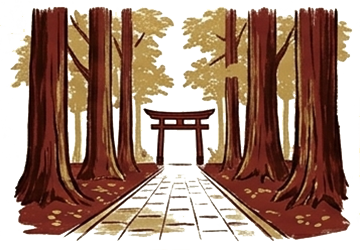
Before Visiting & On the Way
-
Sanpai
Visiting a shrine or temple to pray and pay respects to the deities.
-
Sankei
Making a journey to visit a shrine or temple for worship, with emphasis on the travel itself.
-
Sandō
The pathway leading to a shrine or temple, designed to transition visitors from the secular to the sacred.
-
Omote-sandō
The main and most prestigious approach path to a shrine or temple.
-
Seichū
The center of the approach path, considered the pathway reserved for the gods.
-
Shagōhyō
A stone pillar inscribed with the shrine's name, standing near the entrance of the grounds.
-
Keidai
The sacred grounds within the boundary of a shrine or temple.
-
Gejō / Geba
A stone marker instructing visitors to dismount from horses or vehicles before proceeding to worship.
-
Monzenmachi
A commercial district that developed along the approach to a shrine or temple, serving pilgrims and visitors.
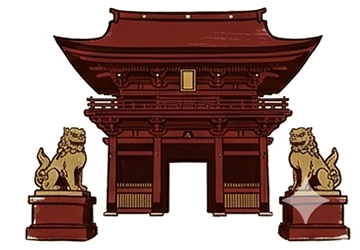
Gates & Entrances
-
Torii
The iconic gate marking the entrance to a shrine, serving as the boundary between the sacred and secular worlds.
-
Ichi-no-Torii
The outermost torii gate of a shrine, marking the very beginning of the sacred approach.
-
Ni-no-Torii
The second torii gate along the approach, marking deeper entry into the sacred grounds.
-
Sanmon
The main gate of a Buddhist temple, symbolizing the entrance to enlightenment.
-
Niōmon
A temple gate flanked by fierce guardian statues (Niō) that protect the sacred grounds from evil.
-
Zuijinmon
A shrine gate guarded by armed deity statues that serve the same protective role as Niō in temples.
-
Rōmon
A two-story gate structure with an upper level, signifying the grandeur and prestige of a shrine.
-
Karamon
An ornate gate featuring a distinctive curved "karahafu" gable, symbolizing the highest architectural prestige.
-
Komainu
A pair of stone guardian creatures placed at shrine entrances to ward off evil spirits.
-
A-Un
A concept representing the beginning and end of all things, expressed through paired open and closed-mouth figures.
-
Tōrō
Lanterns placed along shrine and temple paths to provide illumination and serve as offerings of light.
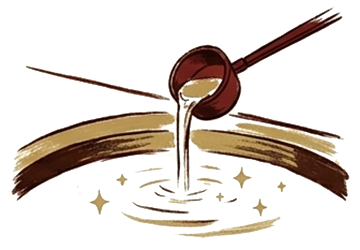
Purification Rituals
-
Temizuya
A water pavilion where visitors cleanse their hands and mouth before worship.
-
Chōzu
The ritual act of purifying hands and mouth with water before worship.
-
Hishaku
A long-handled ladle used to scoop water at the temizuya for ritual purification.
-
Suiban
The stone basin at a temizuya that holds the purification water.
-
Misogi
A purification ritual involving immersion in water to cleanse the body and spirit of impurities.
-
Kegare
A concept of ritual impurity caused by contact with death, illness, or blood, which can be cleansed through purification.
-
Saikai
The practice of abstaining from certain foods and activities to purify oneself before a sacred ritual.

Places of Worship
-
Haiden
The outer hall of a shrine where visitors offer prayers, typically featuring a bell and offering box.
-
Honden
The innermost sacred building of a shrine where the divine object (goshintai) is enshrined.
-
Heiden
The hall between the haiden and honden where offerings are presented to the deity.
-
Hondō
The central building of a Buddhist temple where the principal image of Buddha is enshrined.
-
Gohonzon
The principal object of worship in a Buddhist temple — a statue, painting, or mandala of Buddha.
-
Saisen
A monetary offering tossed into the offering box as a token of gratitude to the gods or Buddha.
-
Saisenbako
A sturdy wooden box placed before the worship hall for visitors to deposit monetary offerings.
-
Suzu
A large bell hung at the front of the worship hall, rung by visitors to announce their presence to the gods.
-
Suzuo
The thick rope or cord used to ring the shrine bell before prayer.
-
Waniguchi
A flat, disc-shaped metal gong hung at temple entrances — the Buddhist equivalent of a shrine bell.
-
Nihai-Nihakushu-Ichihai
The standard Shinto worship sequence: two deep bows, two handclaps, and one final bow.
-
Kashiwade
The practice of clapping hands together during shrine worship to show reverence and announce one's presence.
-
Gasshō
The Buddhist prayer posture of pressing both palms together in front of the chest.
-
Shōkō
The ritual of burning incense at a temple or funeral to honor Buddha or the deceased.
-
Senkō
Thin sticks of incense offered before Buddhist altars to purify the space and nourish the spirit.
-
Kōro
A large incense vessel at temple entrances where visitors waft smoke over themselves for purification.
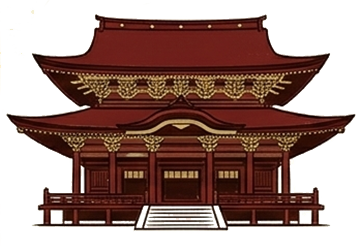
Shrine & Temple Buildings
-
Sessha
A sub-shrine closely related to the main deity, ranking higher than massha in the shrine hierarchy.
-
Massha
A small sub-shrine on the grounds enshrining deities without direct kinship to the main god.
-
Keidaisha
A collective term for all sub-shrines (sessha and massha) within a shrine's grounds.
-
Shaden
A collective term for the buildings of a shrine, including the main sanctuary, worship hall, and related structures.
-
Garan
The layout of a temple's main buildings, derived from the Sanskrit word for “monastery garden.”
-
Juyosho
The counter where visitors receive amulets, talismans, goshuin stamps, and other sacred items.
-
Shamusho
The administrative office of a shrine handling ceremonies, amulet distribution, and daily operations.
-
Kaguraden
A stage building within shrine grounds dedicated to performances of sacred music and dance for the gods.
-
Hōmotsuden
A museum within shrine or temple grounds displaying historically and artistically significant treasures.
-
Emakake
A rack or board where visitors hang their ema prayer tablets within shrine grounds.
-
Goshinboku
A venerated tree within shrine grounds believed to house a divine spirit, often marked with a shimenawa rope.
-
Shimenawa
A rope of twisted rice straw marking the boundary of a sacred space, hung on torii, trees, and buildings.
-
Shinkyo
A sacred bridge on shrine grounds symbolizing the passage from the mortal world to the divine realm.
-
Ishidan
Stone stairways leading to elevated shrine or temple buildings, often serving as a form of physical devotion.
-
Taikobashi
A bridge with a steep arch resembling a drum, found in shrine and temple gardens symbolizing the link between worlds.
-
Tamagaki
A decorative fence enclosing the most sacred areas of a shrine, often bearing the names of donors.
-
Hojochi
A sacred pond within temple or shrine grounds used for the compassionate release of captured creatures.
-
Shoro
A tower structure housing a temple's large bronze bell, rung to mark time and on special occasions.
-
Bonshō
A large bronze bell cast for Buddhist temples, prized for its deep, resonant tone.
-
Gojūnotō
An iconic five-tiered Buddhist tower originally built to enshrine relics of the Buddha.
-
Sanjūnotō
A three-tiered Buddhist pagoda, more numerous than five-story pagodas and often found at regional temples.
-
Hyakudo-ishi
A stone pillar marking the starting point for the devoted practice of making 100 round trips to the shrine in prayer.
Amulets & Lucky Charms
-
Goshuin
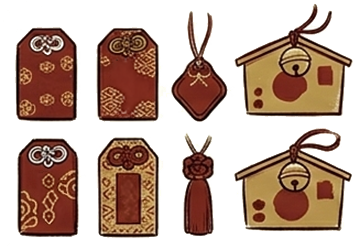
A hand-brushed calligraphy stamp and seal given as proof of worship at a shrine or temple.
-
Goshuinchō
An accordion-fold booklet for collecting goshuin stamps from various shrines and temples.
-
Ofuda
A paper or wooden talisman enshrining divine power, meant to be placed on the home altar or a high, clean location.
-
Omamori
A small fabric amulet containing a sacred inscription, carried for divine protection and good fortune.
-
Omikuji
A paper fortune drawn at shrines and temples revealing one's luck and guidance from the gods.
-
Ema
A wooden prayer tablet hung at shrines, originally a substitute for the offering of real horses.
-
Hamaya
A decorative arrow received at New Year's to ward off evil spirits and bring good fortune.
-
Kumade
An ornate bamboo rake sold at Tori-no-Ichi festivals, symbolizing the raking in of good fortune and prosperity.
-
Taima
A purification implement used in Shinto rituals, or the sacred talisman distributed by Ise Grand Shrine.
-
Sakaki
An evergreen tree sacred to Shinto, used for ritual offerings and tamagushi branches.
-
Omiki
Sake offered to the gods at shrines, later shared with worshippers as a form of communion with the divine.

Priests & Staff
-
Gūji
The highest-ranking priest and chief administrator of a shrine.
-
Negi
A shrine priest ranking directly below the chief priest, assisting in rituals and daily operations.
-
Gon-negi
A junior priest who assists the negi, typically an entry-level position for newly ordained shrine staff.
-
Miko
A female attendant at a shrine who assists with rituals, performs sacred dances, and serves at the amulet counter.
-
Jūshoku
The chief priest and administrator of a Buddhist temple, responsible for all religious and operational affairs.
-
Oshō
An honorific title for a senior Buddhist monk qualified to teach and guide disciples.
-
Sōryo
A general term for ordained Buddhist monks and nuns who have renounced secular life for religious practice.
-
Ujiko
A local resident who belongs to and supports the community shrine as a member of its parish.

Beliefs & Concepts
-
Shintō
Japan's indigenous religion centered on reverence for nature, ancestors, and countless deities called kami.
-
Bukkyō
The religion founded by Shakyamuni Buddha in India, officially introduced to Japan in the 6th century.
-
Shinbutsu Shūgō
The historical fusion of Shinto and Buddhism into a uniquely Japanese combined worship tradition.
-
Ujigami
The local guardian deity who watches over a specific community and its residents.
-
Ubusunagami
The guardian deity of one's birthplace, believed to protect a person throughout their entire life.
-
Saijin
The deity or deities officially enshrined and worshipped at a particular shrine.
-
Goshintai
The sacred physical object in which a deity resides — a mirror, sword, jewel, mountain, or rock.
-
Goriyaku
The blessings and benefits believed to be bestowed by gods or Buddha upon worshippers.
-
Yaoyorozu no Kami
The concept that innumerable gods dwell in all things in nature — the foundation of Shinto animism.
-
Gōshi
The practice of enshrining multiple deities together in a single shrine, often through shrine mergers.
-
Sūkeisha
A person who deeply reveres a particular shrine regardless of geographic proximity.
-
Gongen
A deity concept from the era of Shinto-Buddhist fusion, where Buddha appears in the guise of a Japanese god.
-
Shinshi
Animals considered sacred messengers of specific deities — foxes for Inari, deer for Kasuga, and more.
-
Chinju
A deity that watches over and pacifies a specific area or community — closely related to ujigami.
-
Bunrei
The practice of dividing a deity's spirit to enshrine it at a new location without diminishing the original.
-
Hōnō
The act of presenting offerings — goods, money, or performances — to the gods or Buddha.
-
Engi
A word with dual meaning: the founding legend of a shrine or temple, or an omen of good or bad fortune.
-
Yakudoshi
Specific ages considered prone to misfortune — 42 for men and 33 for women being the most critical.
-
Reigen
The manifest power or miraculous efficacy of a deity or Buddha, often expressed as "reigen arataka."
Rituals & Annual Events
-
Reitaisai
The most important annual festival of a shrine, held on a date significant to the enshrined deity.
-
Hatsumōde
The tradition of making the first shrine or temple visit of the New Year to pray for blessings.
-
Setsubun
The eve of spring celebrated by throwing beans to drive out evil and invite good fortune.
-
Shichi-Go-San
A rite of passage celebrating children's growth at ages 3, 5, and 7 with a shrine visit.
-
Ōharae
A biannual purification ceremony (June 30 and December 31) cleansing the accumulated sins and impurities of six months.
-
Chinowa
A large ring woven from miscanthus grass, set up during Ōharae for visitors to walk through for purification.
-
Yakuyoke
A prayer ritual performed during unlucky years to ward off misfortune and protect against disaster.
-
Jichinsai
A Shinto ritual performed before construction to appease the land deity and pray for building safety.
-
Oharai
A ritual of cleansing sin and impurity using prayer words and the waving of a purification wand.
-
Kitō
A formal prayer ceremony conducted by a priest to petition the gods or Buddha for specific blessings.
-
Norito
Sacred words spoken aloud by Shinto priests to communicate with the gods during ceremonies.
-
Tamagushi Hōten
The Shinto ritual of offering a sakaki branch adorned with paper streamers to the gods — comparable to Buddhist incense offering.
-
Mikoshi
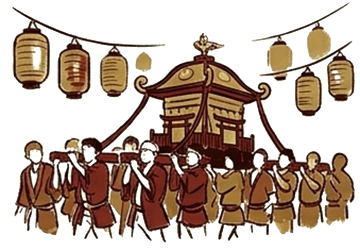
A sacred palanquin carried through the streets during festivals, believed to transport the deity among the people.
-
Obon
A Buddhist observance honoring ancestral spirits who return home during mid-August.
-
Ohyakudo-mairi
An intense devotional practice of walking 100 round trips between a stone marker and the shrine while praying.
Architectural & Decorative Features
-
Shide
White zigzag paper streamers attached to shimenawa ropes and tamagushi offerings, symbolizing purity and the sacred.
-
Chigi
V-shaped wooden beams projecting from the roof ridge of a shrine, a distinctive feature of Shinto architecture.
-
Katsuogi
Horizontal log-shaped ornaments placed along the roof ridge, named for their resemblance to dried bonito.
-
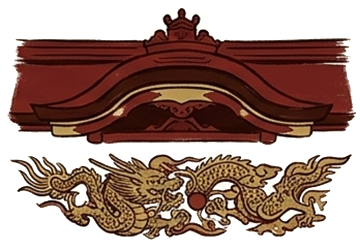
Karahafu
A graceful curved gable used as a decorative element signifying the highest architectural prestige in Japanese buildings.
-
Hengaku
A horizontal plaque hung above a gate or entrance, bearing the name of the shrine or temple in calligraphy.
-
Kairō
A covered walkway encircling the main buildings of a shrine or temple, framing the sacred space.
-
Shinmon
The heraldic crest representing a shrine, analogous to a family crest, found on buildings, lanterns, and sacred objects.
