
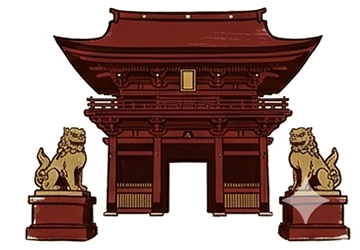
Gates & Entrances
Torii
The iconic gate marking the entrance to a shrine, serving as the boundary between the sacred and secular worlds.
The torii is the most recognizable symbol of a Shinto shrine, serving as a gateway that separates the divine realm from the everyday world. Its origins are debated — one theory links it to the perch where roosters sat to lure the sun goddess Amaterasu from her cave, while others trace it to gate structures in India and China.
Torii come in two major design families: the shinmei type with straight, simple lines, and the myōjin type with inward-leaning pillars and curved top beams. Materials range from wood and stone to metal and concrete. The most famous torii display is at Fushimi Inari Taisha in Kyoto, where approximately 10,000 vermilion torii create the mesmerizing "Senbon Torii" (thousand torii) tunnel, one of the most photographed sites in all of Japan.
-
Torii
The iconic gate marking the entrance to a shrine, serving as the boundary between the sacred and secular worlds.
-
Ichi-no-Torii
The outermost torii gate of a shrine, marking the very beginning of the sacred approach.
-
Ni-no-Torii
The second torii gate along the approach, marking deeper entry into the sacred grounds.
-
Sanmon
The main gate of a Buddhist temple, symbolizing the entrance to enlightenment.
-
Niōmon
A temple gate flanked by fierce guardian statues (Niō) that protect the sacred grounds from evil.
-
Zuijinmon
A shrine gate guarded by armed deity statues that serve the same protective role as Niō in temples.
-
Rōmon
A two-story gate structure with an upper level, signifying the grandeur and prestige of a shrine.
-
Karamon
An ornate gate featuring a distinctive curved "karahafu" gable, symbolizing the highest architectural prestige.
-
Komainu
A pair of stone guardian creatures placed at shrine entrances to ward off evil spirits.
-
A-Un
A concept representing the beginning and end of all things, expressed through paired open and closed-mouth figures.
-
Tōrō
Lanterns placed along shrine and temple paths to provide illumination and serve as offerings of light.
