
Places of Worship
Waniguchi
A flat, disc-shaped metal gong hung at temple entrances — the Buddhist equivalent of a shrine bell.
The waniguchi is a flat, circular bronze instrument with a horizontal slit across its face resembling a crocodile's mouth — hence the name. Where shrines use bells with a clear, high-pitched ring, the waniguchi produces a deep, resonant “gong” characteristic of Buddhist worship spaces.
Waniguchi spread widely during the Kamakura to Muromachi periods. During the era of combined Shinto-Buddhist worship, waniguchi were sometimes hung at shrines as well, and a few remain to this day. Noticing whether a bell or waniguchi hangs at the entrance can be a quick way to distinguish a shrine from a temple.
-
Haiden
The outer hall of a shrine where visitors offer prayers, typically featuring a bell and offering box.
-
Honden
The innermost sacred building of a shrine where the divine object (goshintai) is enshrined.
-
Heiden
The hall between the haiden and honden where offerings are presented to the deity.
-
Hondō
The central building of a Buddhist temple where the principal image of Buddha is enshrined.
-
Gohonzon
The principal object of worship in a Buddhist temple — a statue, painting, or mandala of Buddha.
-
Saisen
A monetary offering tossed into the offering box as a token of gratitude to the gods or Buddha.
-
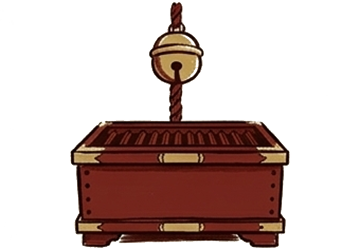
Saisenbako
A sturdy wooden box placed before the worship hall for visitors to deposit monetary offerings.
-
Suzu
A large bell hung at the front of the worship hall, rung by visitors to announce their presence to the gods.
-
Suzuo
The thick rope or cord used to ring the shrine bell before prayer.
-
Waniguchi
A flat, disc-shaped metal gong hung at temple entrances — the Buddhist equivalent of a shrine bell.
-
Nihai-Nihakushu-Ichihai
The standard Shinto worship sequence: two deep bows, two handclaps, and one final bow.
-
Kashiwade
The practice of clapping hands together during shrine worship to show reverence and announce one's presence.
-
Gasshō
The Buddhist prayer posture of pressing both palms together in front of the chest.
-
Shōkō
The ritual of burning incense at a temple or funeral to honor Buddha or the deceased.
-
Senkō
Thin sticks of incense offered before Buddhist altars to purify the space and nourish the spirit.
-
Kōro
A large incense vessel at temple entrances where visitors waft smoke over themselves for purification.
