
Purification Rituals
Kegare
A concept of ritual impurity caused by contact with death, illness, or blood, which can be cleansed through purification.
Kegare refers to spiritual impurity that accumulates through contact with death, blood, illness, and other sources of ritual contamination. In Shinto thought, kegare is also interpreted as "ke-gare" (気枯れ) — a state where one's life force has become depleted. Importantly, kegare is not a sin but a natural condition that anyone can experience and that can be removed through purification rites.
This concept is deeply embedded in Japanese culture. The custom of sprinkling salt after a funeral, or abstaining from shrine visits during a mourning period, both stem from the desire to prevent kegare from entering sacred spaces. While it may seem like a negative concept, the cyclical understanding of impurity — recognizing it, cleansing it, and moving forward — can be seen as ancient wisdom for resetting the mind and body.
-
Temizuya
A water pavilion where visitors cleanse their hands and mouth before worship.
-
Chōzu
The ritual act of purifying hands and mouth with water before worship.
-
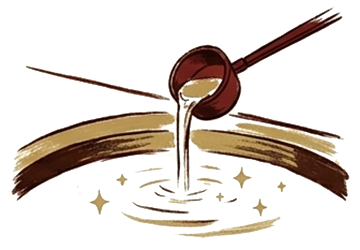
Hishaku
A long-handled ladle used to scoop water at the temizuya for ritual purification.
-
Suiban
The stone basin at a temizuya that holds the purification water.
-
Misogi
A purification ritual involving immersion in water to cleanse the body and spirit of impurities.
-
Kegare
A concept of ritual impurity caused by contact with death, illness, or blood, which can be cleansed through purification.
-
Saikai
The practice of abstaining from certain foods and activities to purify oneself before a sacred ritual.
