
Architectural & Decorative Features
Shinmon
The heraldic crest representing a shrine, analogous to a family crest, found on buildings, lanterns, and sacred objects.
Shinmon are the emblematic crests of shrines — visual symbols equivalent to family "kamon," found on buildings, lanterns, curtains, and sacred objects. They typically feature plants, animals, or objects associated with the enshrined deity, conveying a shrine's identity and lineage at a glance.
Tenmangū shrines use the "umebachi" (plum blossom) crest, reflecting Sugawara no Michizane's love of plum trees. Hachiman shrines display the "mitsu-domoe" (triple comma) design. The imperial "kikuka-mon" (16-petal chrysanthemum) appears at Ise Grand Shrine and imperially connected shrines. Tracking shinmon while visiting shrines reveals networks between related shrines — shared crests indicating shared lineage and spiritual connections.
-
Shide
White zigzag paper streamers attached to shimenawa ropes and tamagushi offerings, symbolizing purity and the sacred.
-
Chigi
V-shaped wooden beams projecting from the roof ridge of a shrine, a distinctive feature of Shinto architecture.
-
Katsuogi
Horizontal log-shaped ornaments placed along the roof ridge, named for their resemblance to dried bonito.
-
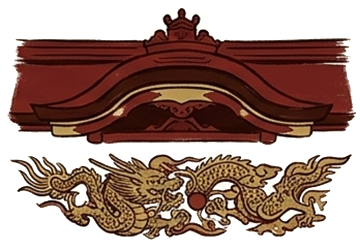
Karahafu
A graceful curved gable used as a decorative element signifying the highest architectural prestige in Japanese buildings.
-
Hengaku
A horizontal plaque hung above a gate or entrance, bearing the name of the shrine or temple in calligraphy.
-
Kairō
A covered walkway encircling the main buildings of a shrine or temple, framing the sacred space.
-
Shinmon
The heraldic crest representing a shrine, analogous to a family crest, found on buildings, lanterns, and sacred objects.
