
Gates & Entrances
Tōrō
Lanterns placed along shrine and temple paths to provide illumination and serve as offerings of light.
Tōrō are lighting structures found along shrine and temple paths, with a fire chamber designed to hold a flame. Stone lanterns are the most common, though bronze metal lanterns and hanging wooden lanterns also exist. Originally introduced alongside Buddhism as a form of offering, lighting a lantern before the Buddha was believed to earn spiritual merit.
Kasuga Taisha in Nara is home to approximately 3,000 stone and hanging lanterns, and twice a year during the Mantōrō festival, every single lantern is lit, creating an ethereal spectacle. Japanese garden design has also developed distinctive tōrō styles — "yukimi-dōrō" (snow-viewing lanterns), "oribe-dōrō," and others — elevating the lantern from a religious fixture to an art form in its own right.
-
Torii
The iconic gate marking the entrance to a shrine, serving as the boundary between the sacred and secular worlds.
-
Ichi-no-Torii
The outermost torii gate of a shrine, marking the very beginning of the sacred approach.
-
Ni-no-Torii
The second torii gate along the approach, marking deeper entry into the sacred grounds.
-
Sanmon
The main gate of a Buddhist temple, symbolizing the entrance to enlightenment.
-
Niōmon
A temple gate flanked by fierce guardian statues (Niō) that protect the sacred grounds from evil.
-
Zuijinmon
A shrine gate guarded by armed deity statues that serve the same protective role as Niō in temples.
-
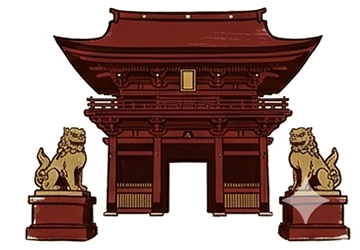
Rōmon
A two-story gate structure with an upper level, signifying the grandeur and prestige of a shrine.
-
Karamon
An ornate gate featuring a distinctive curved "karahafu" gable, symbolizing the highest architectural prestige.
-
Komainu
A pair of stone guardian creatures placed at shrine entrances to ward off evil spirits.
-
A-Un
A concept representing the beginning and end of all things, expressed through paired open and closed-mouth figures.
-
Tōrō
Lanterns placed along shrine and temple paths to provide illumination and serve as offerings of light.
