
Places of Worship
Hondō
The central building of a Buddhist temple where the principal image of Buddha is enshrined.
The hondō is the most important building in a temple complex, housing the principal Buddha image (gohonzon) and serving as the venue for ceremonies and daily devotions. Depending on the sect, it may be called “kondō” (golden hall), “butsuden” (Buddha hall), or “daiōhōden.” Hōryū-ji's kondō is recognized as the world's oldest surviving wooden structure.
The interior is typically divided into the gejin (outer sanctuary for worshippers) and naijin (inner sanctuary housing the Buddha image), separated by a raised platform or lattice barrier. Sanjūsangen-dō in Kyoto boasts the longest hondō in Japan at approximately 120 meters, with 1,001 statues of Senju Kannon standing in breathtaking rows.
-
Haiden
The outer hall of a shrine where visitors offer prayers, typically featuring a bell and offering box.
-
Honden
The innermost sacred building of a shrine where the divine object (goshintai) is enshrined.
-
Heiden
The hall between the haiden and honden where offerings are presented to the deity.
-
Hondō
The central building of a Buddhist temple where the principal image of Buddha is enshrined.
-
Gohonzon
The principal object of worship in a Buddhist temple — a statue, painting, or mandala of Buddha.
-
Saisen
A monetary offering tossed into the offering box as a token of gratitude to the gods or Buddha.
-
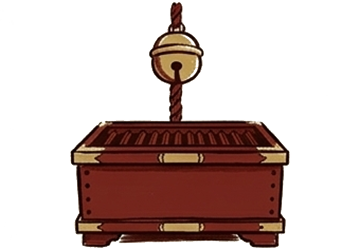
Saisenbako
A sturdy wooden box placed before the worship hall for visitors to deposit monetary offerings.
-
Suzu
A large bell hung at the front of the worship hall, rung by visitors to announce their presence to the gods.
-
Suzuo
The thick rope or cord used to ring the shrine bell before prayer.
-
Waniguchi
A flat, disc-shaped metal gong hung at temple entrances — the Buddhist equivalent of a shrine bell.
-
Nihai-Nihakushu-Ichihai
The standard Shinto worship sequence: two deep bows, two handclaps, and one final bow.
-
Kashiwade
The practice of clapping hands together during shrine worship to show reverence and announce one's presence.
-
Gasshō
The Buddhist prayer posture of pressing both palms together in front of the chest.
-
Shōkō
The ritual of burning incense at a temple or funeral to honor Buddha or the deceased.
-
Senkō
Thin sticks of incense offered before Buddhist altars to purify the space and nourish the spirit.
-
Kōro
A large incense vessel at temple entrances where visitors waft smoke over themselves for purification.
