
Purification Rituals
Chōzu
The ritual act of purifying hands and mouth with water before worship.
Chōzu refers to the act of cleansing hands and mouth at a temizuya. Anciently, worshippers would purify their bodies in rivers before sacred rituals, but as this was impractical for all visitors, the simplified practice of hand and mouth rinsing became standard.
The word "chōzu" evolved from "temizu" (hand water) through phonetic change, and it also became a euphemism for the bathroom, similar to "restroom" or "lavatory" in English. In the world of tea ceremony, guests purify their hands at a "tsukubai" (crouching basin) before entering the tea room — demonstrating how the Japanese reverence for cleanliness permeates culture far beyond religious settings.
-
Temizuya
A water pavilion where visitors cleanse their hands and mouth before worship.
-
Chōzu
The ritual act of purifying hands and mouth with water before worship.
-
Hishaku
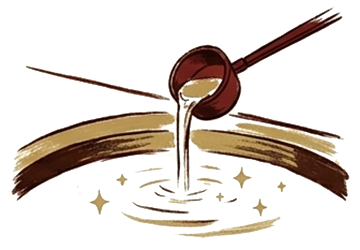
A long-handled ladle used to scoop water at the temizuya for ritual purification.
-
Suiban
The stone basin at a temizuya that holds the purification water.
-
Misogi
A purification ritual involving immersion in water to cleanse the body and spirit of impurities.
-
Kegare
A concept of ritual impurity caused by contact with death, illness, or blood, which can be cleansed through purification.
-
Saikai
The practice of abstaining from certain foods and activities to purify oneself before a sacred ritual.
