
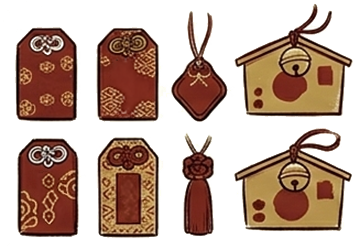
Amulets & Lucky Charms
Omikuji
A paper fortune drawn at shrines and temples revealing one's luck and guidance from the gods.
Omikuji are fortune slips drawn at random to divine the will of the gods, featuring a ranking of fortune alongside a classical poem and advice on specific life areas. The word "kuji" derives from "kushi" (skewer), referring to the ancient practice of drawing lots with bamboo sticks. The modern paper format is attributed to the Buddhist monk Ganzan Daishi Ryōgen.
The fortune hierarchy typically runs: daikichi (great blessing), kichi (blessing), chūkichi (moderate blessing), shōkichi (small blessing), suekichi (future blessing), kyō (curse), daikyō (great curse) — though the order and categories vary by shrine. Drawing an unfavorable fortune traditionally means tying it to a tree or rack at the shrine to "leave the bad luck behind." More important than the ranking itself is reading and reflecting on the written advice as guidance for daily life.
-
Goshuin
A hand-brushed calligraphy stamp and seal given as proof of worship at a shrine or temple.
-
Goshuinchō
An accordion-fold booklet for collecting goshuin stamps from various shrines and temples.
-
Ofuda
A paper or wooden talisman enshrining divine power, meant to be placed on the home altar or a high, clean location.
-
Omamori
A small fabric amulet containing a sacred inscription, carried for divine protection and good fortune.
-
Omikuji
A paper fortune drawn at shrines and temples revealing one's luck and guidance from the gods.
-
Ema
A wooden prayer tablet hung at shrines, originally a substitute for the offering of real horses.
-
Hamaya
A decorative arrow received at New Year's to ward off evil spirits and bring good fortune.
-
Kumade
An ornate bamboo rake sold at Tori-no-Ichi festivals, symbolizing the raking in of good fortune and prosperity.
-
Taima
A purification implement used in Shinto rituals, or the sacred talisman distributed by Ise Grand Shrine.
-
Sakaki
An evergreen tree sacred to Shinto, used for ritual offerings and tamagushi branches.
-
Omiki
Sake offered to the gods at shrines, later shared with worshippers as a form of communion with the divine.
