
Places of Worship
Heiden
The hall between the haiden and honden where offerings are presented to the deity.
The heiden is positioned between the worship hall (haiden) and the main sanctuary (honden), serving as the space where heihaku — offerings of silk, cotton, paper, food, and money — are presented to the gods. In some shrines it functions as a connecting corridor between the two main buildings.
The term “heihaku” encompasses all items offered before the gods. At Ise Grand Shrine, the ancient “Kanmiso-sai” ceremony continues to this day, offering bolts of silk and hemp cloth to the deities. While visitors rarely think about the heiden, it plays a vital role as the intermediary space connecting the human and divine realms within shrine architecture.
-
Haiden
The outer hall of a shrine where visitors offer prayers, typically featuring a bell and offering box.
-
Honden
The innermost sacred building of a shrine where the divine object (goshintai) is enshrined.
-
Heiden
The hall between the haiden and honden where offerings are presented to the deity.
-
Hondō
The central building of a Buddhist temple where the principal image of Buddha is enshrined.
-
Gohonzon
The principal object of worship in a Buddhist temple — a statue, painting, or mandala of Buddha.
-
Saisen
A monetary offering tossed into the offering box as a token of gratitude to the gods or Buddha.
-
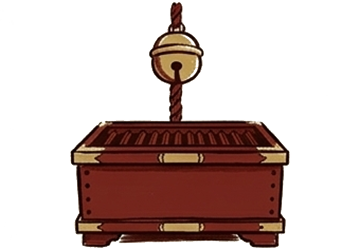
Saisenbako
A sturdy wooden box placed before the worship hall for visitors to deposit monetary offerings.
-
Suzu
A large bell hung at the front of the worship hall, rung by visitors to announce their presence to the gods.
-
Suzuo
The thick rope or cord used to ring the shrine bell before prayer.
-
Waniguchi
A flat, disc-shaped metal gong hung at temple entrances — the Buddhist equivalent of a shrine bell.
-
Nihai-Nihakushu-Ichihai
The standard Shinto worship sequence: two deep bows, two handclaps, and one final bow.
-
Kashiwade
The practice of clapping hands together during shrine worship to show reverence and announce one's presence.
-
Gasshō
The Buddhist prayer posture of pressing both palms together in front of the chest.
-
Shōkō
The ritual of burning incense at a temple or funeral to honor Buddha or the deceased.
-
Senkō
Thin sticks of incense offered before Buddhist altars to purify the space and nourish the spirit.
-
Kōro
A large incense vessel at temple entrances where visitors waft smoke over themselves for purification.
