
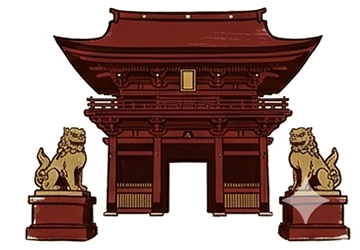
Gates & Entrances
Sanmon
The main gate of a Buddhist temple, symbolizing the entrance to enlightenment.
Sanmon is the formal main gate of a Buddhist temple, also written as "三門" (three gates), an abbreviation of "sangedatsu-mon" — the gate of three liberations, representing the Buddhist concepts of emptiness, formlessness, and wishlessness. Passing through the sanmon symbolically represents leaving the world of suffering and entering the Buddha's realm.
The upper story of a sanmon typically houses Buddhist statues such as Shakyamuni Buddha and the Sixteen Arhats. Nanzen-ji's sanmon in Kyoto is famous as the setting for the kabuki play where the legendary thief Ishikawa Goemon declares "What a magnificent view!" — though this scene is theatrical fiction. The actual sanmon stands approximately 22 meters tall and offers a genuine panoramic view of Kyoto from its upper level.
-
Torii
The iconic gate marking the entrance to a shrine, serving as the boundary between the sacred and secular worlds.
-
Ichi-no-Torii
The outermost torii gate of a shrine, marking the very beginning of the sacred approach.
-
Ni-no-Torii
The second torii gate along the approach, marking deeper entry into the sacred grounds.
-
Sanmon
The main gate of a Buddhist temple, symbolizing the entrance to enlightenment.
-
Niōmon
A temple gate flanked by fierce guardian statues (Niō) that protect the sacred grounds from evil.
-
Zuijinmon
A shrine gate guarded by armed deity statues that serve the same protective role as Niō in temples.
-
Rōmon
A two-story gate structure with an upper level, signifying the grandeur and prestige of a shrine.
-
Karamon
An ornate gate featuring a distinctive curved "karahafu" gable, symbolizing the highest architectural prestige.
-
Komainu
A pair of stone guardian creatures placed at shrine entrances to ward off evil spirits.
-
A-Un
A concept representing the beginning and end of all things, expressed through paired open and closed-mouth figures.
-
Tōrō
Lanterns placed along shrine and temple paths to provide illumination and serve as offerings of light.
