
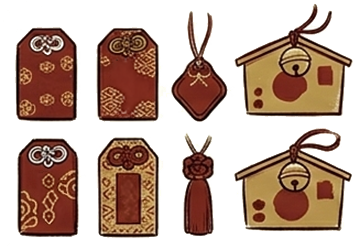
Amulets & Lucky Charms
Taima
A purification implement used in Shinto rituals, or the sacred talisman distributed by Ise Grand Shrine.
In Shinto, "taima" refers either to a purification wand (ōnusa) made from a sakaki branch with hemp and paper streamers, waved by priests to cleanse worshippers of impurities, or to the "Jingū Taima" — the sacred talisman of Ise Grand Shrine distributed nationwide. The term also reads "ōnusa."
The Jingū Taima carries a portion of the spirit of Amaterasu Ōmikami and is the most widely enshrined talisman in Japan. While the characters might cause confusion in modern contexts, "taima" originally meant "great hemp" — hemp being considered a ritually pure plant essential to Shinto ceremonies. Shimenawa ropes and heihaku offerings also traditionally use hemp fibers for this reason.
-
Goshuin
A hand-brushed calligraphy stamp and seal given as proof of worship at a shrine or temple.
-
Goshuinchō
An accordion-fold booklet for collecting goshuin stamps from various shrines and temples.
-
Ofuda
A paper or wooden talisman enshrining divine power, meant to be placed on the home altar or a high, clean location.
-
Omamori
A small fabric amulet containing a sacred inscription, carried for divine protection and good fortune.
-
Omikuji
A paper fortune drawn at shrines and temples revealing one's luck and guidance from the gods.
-
Ema
A wooden prayer tablet hung at shrines, originally a substitute for the offering of real horses.
-
Hamaya
A decorative arrow received at New Year's to ward off evil spirits and bring good fortune.
-
Kumade
An ornate bamboo rake sold at Tori-no-Ichi festivals, symbolizing the raking in of good fortune and prosperity.
-
Taima
A purification implement used in Shinto rituals, or the sacred talisman distributed by Ise Grand Shrine.
-
Sakaki
An evergreen tree sacred to Shinto, used for ritual offerings and tamagushi branches.
-
Omiki
Sake offered to the gods at shrines, later shared with worshippers as a form of communion with the divine.
