
Before Visiting & On the Way
Keidai
The sacred grounds within the boundary of a shrine or temple.
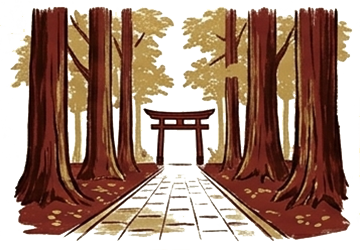
Keidai literally means "within the boundary," referring to the holy space enclosed within the spiritual perimeter marked by torii gates or temple gates. Once you step through these markers, you have entered the realm of the divine. Within the keidai, you will find the main hall, worship hall, purification fountain, sub-shrines, and various other sacred structures.
The largest shrine grounds in Japan belong to Ise Grand Shrine, where the combined sacred forest of the Inner and Outer Shrines covers approximately 5,500 hectares — equivalent to about 1,170 Tokyo Domes. Most of this vast area is covered by ancient forest that has been carefully preserved for over a thousand years, making it one of Japan's most significant primeval woodland areas.
-
Sanpai
Visiting a shrine or temple to pray and pay respects to the deities.
-
Sankei
Making a journey to visit a shrine or temple for worship, with emphasis on the travel itself.
-
Sandō
The pathway leading to a shrine or temple, designed to transition visitors from the secular to the sacred.
-
Omote-sandō
The main and most prestigious approach path to a shrine or temple.
-
Seichū
The center of the approach path, considered the pathway reserved for the gods.
-
Shagōhyō
A stone pillar inscribed with the shrine's name, standing near the entrance of the grounds.
-
Keidai
The sacred grounds within the boundary of a shrine or temple.
-
Gejō / Geba
A stone marker instructing visitors to dismount from horses or vehicles before proceeding to worship.
-
Monzenmachi
A commercial district that developed along the approach to a shrine or temple, serving pilgrims and visitors.
