
Gates & Entrances
Karamon
An ornate gate featuring a distinctive curved "karahafu" gable, symbolizing the highest architectural prestige.
The karamon features a gracefully arched "karahafu" (cusped gable) on its front and rear, making it one of the most decorative gate styles in Japanese architecture. Despite the character "kara" (Chinese), this style is not of Chinese origin but developed uniquely in Japan. It was used to mark entrances of the highest status — shrines, temples, castles, and palaces alike.
The karamon at Nikkō Tōshōgū is covered in exquisite carvings, while the karamon at Nishi Hongan-ji temple in Kyoto earned the nickname "Higurashi-mon" — the "twilight gate" — because its beauty was said to keep observers gazing until the sun set. These gates represent some of the finest examples of Japanese architectural artistry.
-
Torii
The iconic gate marking the entrance to a shrine, serving as the boundary between the sacred and secular worlds.
-
Ichi-no-Torii
The outermost torii gate of a shrine, marking the very beginning of the sacred approach.
-
Ni-no-Torii
The second torii gate along the approach, marking deeper entry into the sacred grounds.
-
Sanmon
The main gate of a Buddhist temple, symbolizing the entrance to enlightenment.
-
Niōmon
A temple gate flanked by fierce guardian statues (Niō) that protect the sacred grounds from evil.
-
Zuijinmon
A shrine gate guarded by armed deity statues that serve the same protective role as Niō in temples.
-
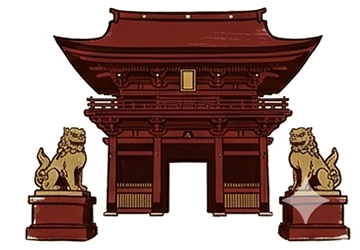
Rōmon
A two-story gate structure with an upper level, signifying the grandeur and prestige of a shrine.
-
Karamon
An ornate gate featuring a distinctive curved "karahafu" gable, symbolizing the highest architectural prestige.
-
Komainu
A pair of stone guardian creatures placed at shrine entrances to ward off evil spirits.
-
A-Un
A concept representing the beginning and end of all things, expressed through paired open and closed-mouth figures.
-
Tōrō
Lanterns placed along shrine and temple paths to provide illumination and serve as offerings of light.
