
Architectural & Decorative Features
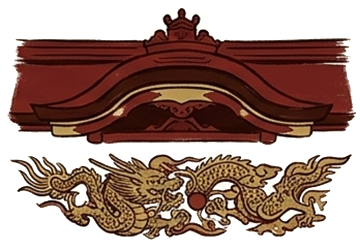
Karahafu
A graceful curved gable used as a decorative element signifying the highest architectural prestige in Japanese buildings.
Karahafu is a distinctive undulating roof ornament — curving upward at the center and swooping down at the sides — representing the pinnacle of prestigious Japanese architecture. Despite the "kara" (Chinese) in its name, this style developed uniquely in Japan and has no Chinese equivalent. It adorns shrines, temples, castles, and palaces to signal the highest status.
The flowing curves of karahafu demand exceptional carpentry skill, and their elegant lines represent the apex of Japanese architectural aesthetics. Surprisingly, karahafu also appeared on traditional public bathhouses — the "miyazukuri" (shrine-style) bathhouse architecture that flourished in the Shōwa era brought sacred architectural grandeur to the most everyday of buildings, showcasing the playful depth of Japanese building culture.
-
Shide
White zigzag paper streamers attached to shimenawa ropes and tamagushi offerings, symbolizing purity and the sacred.
-
Chigi
V-shaped wooden beams projecting from the roof ridge of a shrine, a distinctive feature of Shinto architecture.
-
Katsuogi
Horizontal log-shaped ornaments placed along the roof ridge, named for their resemblance to dried bonito.
-
Karahafu
A graceful curved gable used as a decorative element signifying the highest architectural prestige in Japanese buildings.
-
Hengaku
A horizontal plaque hung above a gate or entrance, bearing the name of the shrine or temple in calligraphy.
-
Kairō
A covered walkway encircling the main buildings of a shrine or temple, framing the sacred space.
-
Shinmon
The heraldic crest representing a shrine, analogous to a family crest, found on buildings, lanterns, and sacred objects.
