
Gates & Entrances
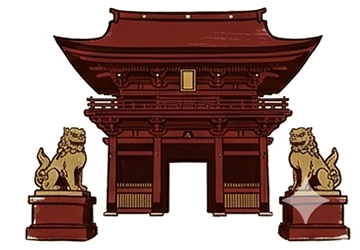
Niōmon
A temple gate flanked by fierce guardian statues (Niō) that protect the sacred grounds from evil.
The niōmon features a pair of muscular guardian figures — the Kongōrikishi — stationed on either side to ward off evil spirits and protect the temple grounds. The right figure has an open mouth (a-gyō) and the left has a closed mouth (un-gyō), representing "a-un," the beginning and end of all things in the universe.
The most celebrated Niō statues in Japan are those at Tōdai-ji's Great South Gate in Nara, carved by the master sculptors Unkei and Kaikei in just 69 days during the Kamakura period. Standing approximately 8.4 meters tall, these wooden giants are considered among the greatest masterpieces in the history of Japanese sculpture. Taking a moment to study the dynamic musculature and flowing drapery reveals the extraordinary skill concentrated in these works.
-
Torii
The iconic gate marking the entrance to a shrine, serving as the boundary between the sacred and secular worlds.
-
Ichi-no-Torii
The outermost torii gate of a shrine, marking the very beginning of the sacred approach.
-
Ni-no-Torii
The second torii gate along the approach, marking deeper entry into the sacred grounds.
-
Sanmon
The main gate of a Buddhist temple, symbolizing the entrance to enlightenment.
-
Niōmon
A temple gate flanked by fierce guardian statues (Niō) that protect the sacred grounds from evil.
-
Zuijinmon
A shrine gate guarded by armed deity statues that serve the same protective role as Niō in temples.
-
Rōmon
A two-story gate structure with an upper level, signifying the grandeur and prestige of a shrine.
-
Karamon
An ornate gate featuring a distinctive curved "karahafu" gable, symbolizing the highest architectural prestige.
-
Komainu
A pair of stone guardian creatures placed at shrine entrances to ward off evil spirits.
-
A-Un
A concept representing the beginning and end of all things, expressed through paired open and closed-mouth figures.
-
Tōrō
Lanterns placed along shrine and temple paths to provide illumination and serve as offerings of light.
